Capsule Pressure Gauges
Capsule Pressure Gauges
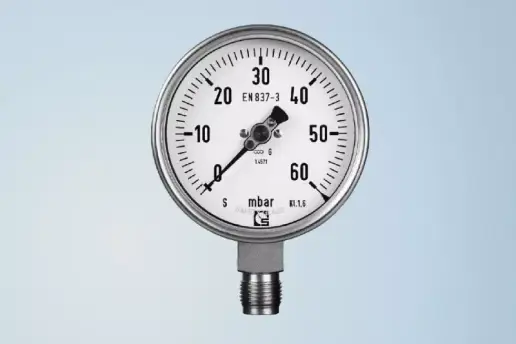
Functionality
Capsule pressure gauges measure low positive and negative pressures using a capsule element.
The capsule consists of two thin, corrugated membranes that are hermetically sealed together.
When pressure is applied to the inside of the capsule, it expands or contracts.
This movement is mechanically transferred to the pointer via the movement and displayed on the scale for accurate pressure measurement.
Design and Construction
A capsule pressure gauge consists of the following main components:
- Capsule: Two thin, corrugated membranes joined together. It reacts to pressure changes by expanding or contracting.
- Movement: Transmits the capsule movement to the pointer.
- Case and connection: Protect the internal components and provide the process connection.
Measurement ranges and accuracy
Capsule pressure gauges are designed for low pressure measurement:
- Positive pressure up to 600 mbar
- Negative pressure up to –600 mbar
The standard accuracy is 1,6 % or 2,5 % of the full-scale value.
Materials and limitations
The capsule is typically made of non-ferrous metals or stainless steel (e.g. 316Ti). These capsule pressure gauges are intended exclusively for clean gaseous media. They are not suitable for liquids.
Temperature ranges
- Ambient temperature: –20 °C to +60 °C
- Medium temperature: up to +100 °C
Advantages
- Well suited for measuring very low positive and negative pressures (vacuum).
- Simple mechanical design
- Good readability and reliable pressure measurement performance in the low pressure range.
- Suitable for a wide range of gaseous media when the correct material is selected.
Disadvantages
- Limited pressure range (maximum ±600 mbar)
- Only suitable for clean gaseous media, not for liquids
- Accuracy is lower compared to other industrial pressure gauges.
- Medium temperature is limited to +100 °C
- Regular calibration is recommended to maintain accuracy over time
Applications
Capsule pressure gauges are commonly used for low pressure measurement and vacuum in applications such as:
- Ventilation and air conditioning systems
- Filter monitoring
- Gas supply systems
- Laboratory and environmental technology
- Pneumatic systems