Differential pressure gauges
Differential Pressure Gauges
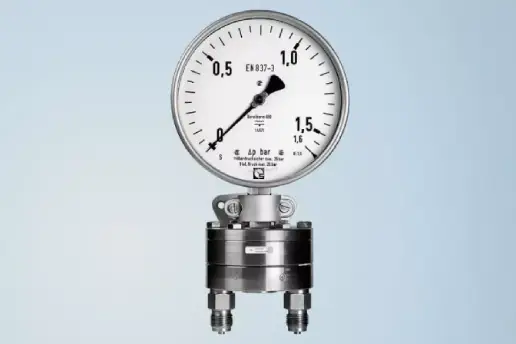
Functionality
Differential pressure gauges measure the difference between two pressures. A thin, corrugated metal diaphragm separates the measuring chamber into two sides. Pressure is applied to both sides of the diaphragm, with the measuring pressure acting on one side. The deflection of the diaphragm is transferred via a pass-through bellow to the movement. On the opposite side, a compensating mechanism balances the forces to ensure accurate differential pressure measurement.
Design and Construction
A differential pressure gauge consists of the following main components:
- Diaphragm: Thin, corrugated metal membrane that separates the two pressure chambers.
- Pass-through bellow: Transfers the diaphragm movement to the movement while maintaining separation between the pressure sides.
- Movement: Converts the diaphragm deflection into a pointer movement.
- Case and connections: Protect the internal components and provide the high- and low-pressure connections.
Measurement ranges and accuracy
Differential pressure gauges are available in various differential pressure measurement ranges. The standard accuracy is 1,6 % or 2,5 % of the full-scale value. The maximum static pressure (overpressure on one side) is typically 25 bar, with special versions available up to 400 bar.
Materials
The wetted parts can be selected according to the process medium. For aggressive media, diaphragm seals with special materials and coatings are available to ensure compatibility and long service life in industrial pressure measurement applications.
Temperature ranges (without diaphragm seals)
- Ambient temperature: –20 °C to +60 °C
- Medium temperature: up to +100 °C
- Medium temperatures with diaphragm seals: up to 420°C
Advantages
- Suitable for measuring differential pressure in both gaseous and liquid media, including aggressive fluids.
- Robust mechanical design with good long-term stability.
- Effective compensation mechanism for accurate differential pressure measurement.
- Available with high static pressure ratings (up to 100 bar in special versions).
- Wide range of material options for different process conditions.
Disadvantages
- Accuracy is typically 1,6 % or 2,5 %, which is lower than that of electronic differential pressure transmitters
- Medium temperature is limited to +100 °C without the diaphragm seals
- Requires correct material selection and diaphragm seals when using with aggressive media
- Regular calibration and maintenance are recommended to maintain accuracy over time
- More complex design compared to standard pressure gauges, which can affect cost and maintenance
Applications
Differential pressure gauges are commonly used for pressure monitoring in applications such as:
- Filter monitoring
- Level measurement in closed vessels
- Flow measurement (in combination with orifice plates or venturi tubes)
- Pump and compressor monitoring Chemical and petrochemical processes