Bimetal thermometers
Bimetal Thermometers
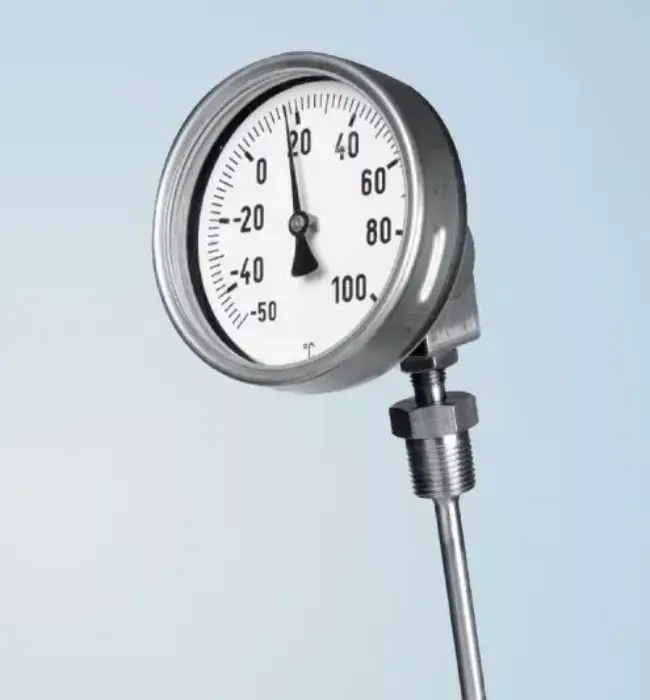
Functionality
Bimetal thermometers measure temperature based on the different thermal expansion of two metals. The measuring element consists of two metal strips with different coefficients of thermal expansion that are welded together. When the temperature changes, the bimetal bends or twists. This mechanical movement is transferred directly to the pointer and displayed on the dial for accurate temperature measurement.
Design and Construction
A bimetal thermometer consists of the following main components:
- Bimetal coil: The core measuring element made of two welded metal strips with different expansion rates.
- Stem: Protects the bimetal coil and connects it to the process.
- Pointer axle and movement: Transmits the twisting motion of the bimetal to the pointer.
- Dial: Displays the measured temperature.
- Thermowell (Optional): Protects the measuring element from corrosive medium or flow.
The simple and robust mechanical design requires no fill fluid and ensures reliable local temperature indication.
Measurement ranges and accuracy
Bimetal thermometers are suitable for temperatures from –50 °C to +500 °C. The standard accuracy is ±1 % of the full-scale deflection.
Advantages
- Robust and simple mechanical design with no fill fluid required.
- Relative stability towards atmospheric temperature changes compared to gas-filled thermometers.
- Good reliability for local temperature measurement.
- Wide temperature range from –50 °C to +500 °C.
- Low maintenance due to the absence of filling liquids.
- Cost-effective solution for many industrial applications.
Disadvantages
- Accuracy is lower compared to electronic temperature sensors.
- Local temperature indication (no remote reading via capillary).
- Response time is slower than electrical thermometers or gas-filled thermometers.
- Can be affected by strong vibration or mechanical shock.
- Regular calibration is recommended to maintain temperature measurement accuracy over time.