|
|
|
|
|
|
|
|
Gas-filled Dial Thermometers
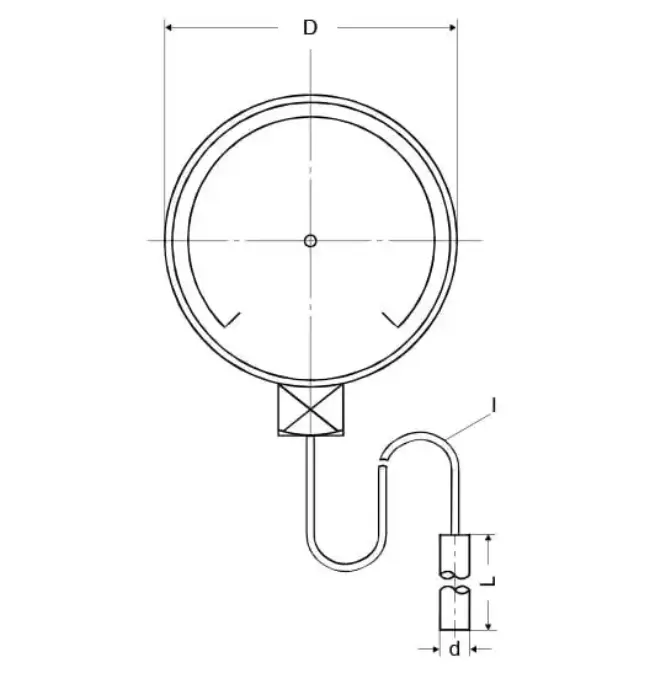
Functionality
Gas-filled dial thermometers measure temperature based on the volumetric expansion of a gas filling inside a measuring element. The temperature change causes the gas to expand or contract. This movement is transmitted through a capillary tube to a measuring spring, which converts the expansion into a pointer movement for accurate temperature measurement on the dial.
Design and Construction
A gas-filled dial thermometer consists of the following main components:
- Measuring element: Contains the gas filling and reacts to temperature changes.
- Capillary tube: Connects the measuring element to the measuring spring (available in lengths up to 100 m).
- Measuring spring: Converts the gas expansion into mechanical movement.
- Movement and dial: Displays the measured temperature.
- Thermowell (Optional): Protects the measuring element from corrosive medium or flow.
The robust construction allows reliable temperature measurement even over long distances between the measuring point and the display.
Measurement ranges and accuracy
Gas-filled dial thermometers cover a wide temperature range from –80 °C to +800 °C. The standard accuracy is ±1 % of the full-scale deflection. Special measuring ranges and multiple scale dials are available on request.
Advantages
- Wide temperature range from –80 °C to +800 °C
- Usable in all kinds of environments with specialized thermowells
- Suitable for remote temperature measurement with capillary lengths up to 100 m
- Can be used with magnetic and inductive contacts as well as 4-20mA output
- Good accuracy for mechanical thermometers (std. ±1 % - up to 0,6%)
- Quick response time in regards to bimetallic gauges
- Robust design for industrial applications
- Flexible configuration with special ranges and scale designs
Disadvantages
- Accuracy is lower compared to electronic temperature sensors
- More prone to measurement deviations due to atmospheric temperature changes
- Response time can be longer than with resistance thermometers or thermocouples
- Capillary tube requires careful handling and installation to avoid damage
- Regular calibration is recommended to maintain temperature measurement accuracy over time.
Applications
Gas-filled dial thermometers are used in various industrial applications where reliable local or remote temperature measurement is required, such as:
- Chemical and petrochemical industry
- Mechanical engineering and plant construction
- Energy and power generation
- Process monitoring with long distances between measuring point and display.