|
|
|
|
|
|
|
|
|
|
|
|
|
Diaphragm Pressure Gauges
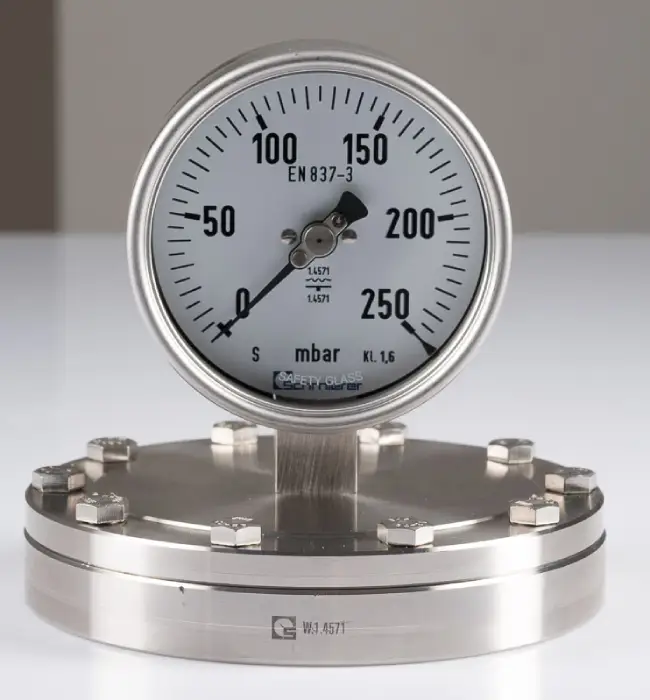
Functionality
Diaphragm pressure gauges measure pressure using a thin, corrugated diaphragm mounted between two flanges.
When pressure is applied to one side of the diaphragm, it deflects. This deflection is mechanically transferred to the movement and displayed on the gauge scale for reliable pressure measurement.
The design makes these industrial pressure gauges particularly suitable for demanding process conditions.
Design and Construction
A diaphragm pressure gauge consists of the following main components:
- Diaphragm: A corrugated membrane that reacts to pressure changes.
- Flanges: Secure the diaphragm and connect the gauge to the process.
- Movement: Transmits the diaphragm deflection to the pointer.
- Case and connection: Protect the internal components and provide the process connection.
The modular design allows easy adaptation to different requirements and supports long-term reliability and simple maintenance for industrial pressure measurement.
Measurement ranges and accuracy
Diaphragm pressure gauges cover the following ranges:
- Positive pressure up to 40 bar
- Negative pressure up to –1 bar
The standard accuracy is 1.6% or 2.5% of the full-scale value. Higher accuracy is available for specific applications upon request, ensuring reliable pressure measurement.
Materials and protection
The wetted parts can be selected to suit the process medium:
- Diaphragm protection with special materials and coatings such as PTFE or Tantalum.
- Process connections available in stainless steel (e.g. 316Ti), Hastelloy C22, PP, PVDF, PVC and other resistant materials.
This makes the diaphragm pressure gauges suitable for pressure measurement in aggressive, corrosive, and abrasive media.
Applications
Diaphragm pressure gauges with an open measuring flange are especially suitable for industrial pressure measurement in:
- Viscous media
- Crystallizing media
- Media containing solid particles
The robust design also allows effective protection against overpressure.
Temperature ranges
- Ambient temperature: –20 °C to +60 °C
- Medium temperature: up to +180 °C (special versions up to +350 °C)
Advantages
- Very suitable for viscous, crystallizing and solids-containing media thanks to the open measuring flange.
- High resistance to aggressive and corrosive media through special diaphragm coatings (e.g. PTFE, Tantalum) and a wide range of connection materials.
- Effective overpressure protection possible with a more rugged design compared to Bourdon tube pressure gauges.
- Modular design enables high flexibility, short delivery times and easy maintenance.
- Low cost of ownership through long service life and repair-friendly construction.
- Reliable pressure measurement performance in demanding process conditions across various industries.
Disadvantages
- Lower accuracy compared to electronic pressure transmitters or Bourdon tube gauges (typically 1,6 % or 2,5 %).
- Limited pressure range (maximum 40 bar positive pressure).
- Requires correct material selection of diaphragm and wetted parts for aggressive media to avoid damage.
- Mechanical design requires periodic calibration and maintenance for consistent long-term pressure measurement accuracy.